Last updated on: April 20, 2026
Table of Contents
BIM dimensions refer to the specific types of data and information that can be added to a Building Information Model beyond its basic three-dimensional geometry. Each dimension represents a distinct category of project information, including time (4D), cost (5D), sustainability (6D), and facility management (7D). Together, they extend the model from a design tool into a comprehensive project management and lifecycle information platform.
The concept of BIM dimensions reflects how a building project generates different types of information at different stages. A structural engineer needs geometry. A project manager needs schedule. A quantity surveyor needs cost. A sustainability consultant needs energy data. A facility manager needs maintenance records. BIM dimensions create a framework for linking all of this information to the same underlying model, so that changes in one area are reflected across all others.
It is worth noting that the term BIM dimensions is used broadly across the industry. Different organisations and standards bodies define the dimensions slightly differently, and some extend the framework to 8D (safety) or beyond (9D and 10D). The five dimensions covered in this guide, from 3D through 7D, represent the most widely adopted and contractually referenced framework in the AEC industry today.
BIM Dimensions at a Glance
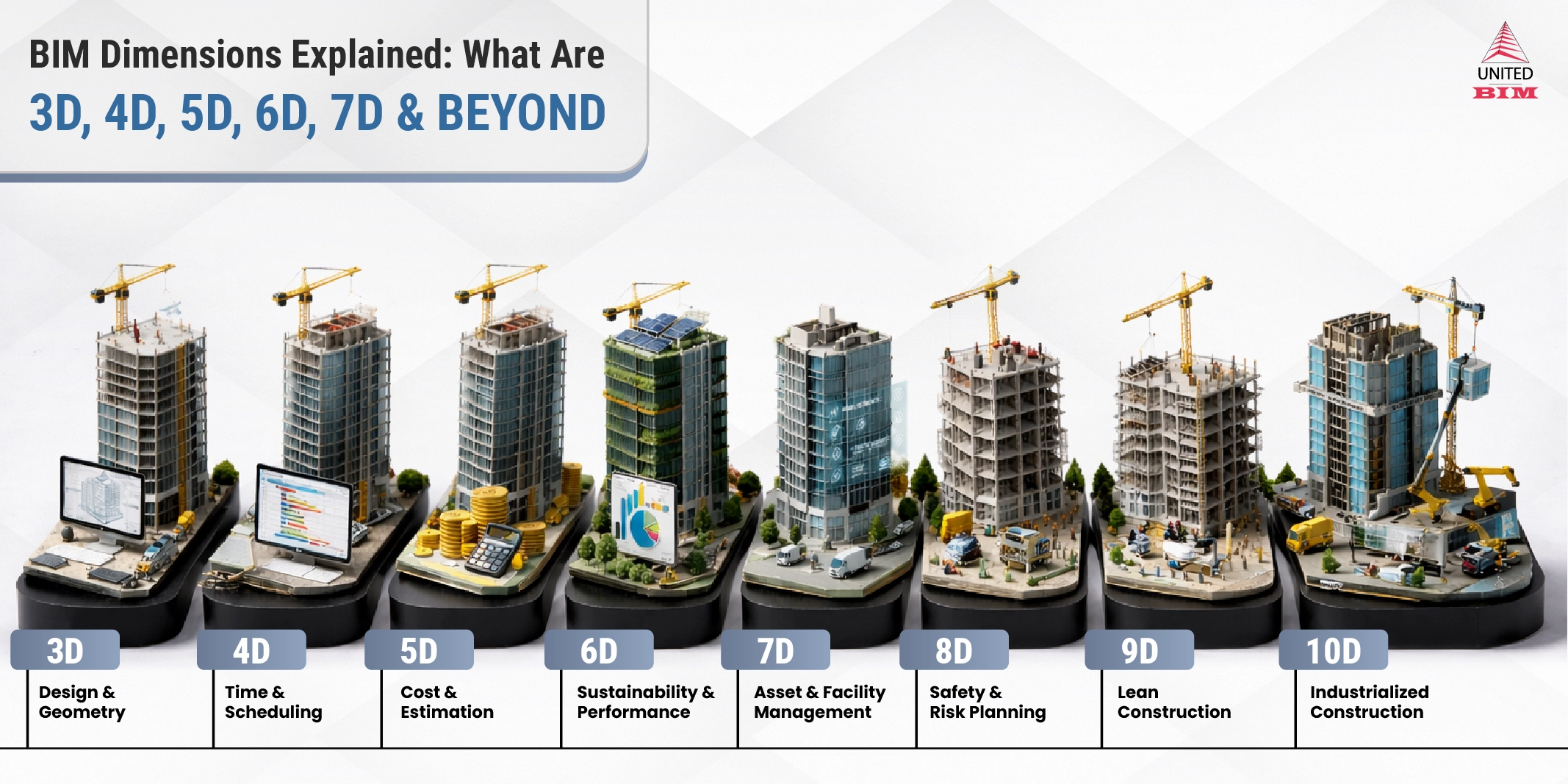
The table below gives a one-line summary of each dimension before the detailed explanations that follow.
| Dimension | Name | What it adds to the model | Primary Benefit |
|---|---|---|---|
| 3D | Geometry | Three-dimensional spatial model (x, y, z) | Visualisation, clash detection, coordination |
| 4D | Time | Construction schedule and sequencing data | Site planning, delay reduction, phasing clarity |
| 5D | Cost | Cost data linked to model elements | Real-time cost tracking, budget control |
| 6D | Sustainability | Energy and lifecycle performance data | Energy efficiency, sustainability compliance |
| 7D | Facility Management | Asset, maintenance, and operations data | Efficient building operations over its full life |
| 8D | Safety | Risk assessments, safety planning data | Improved site safety, risk mitigation |
| 9D | Lean Construction | Productivity, workflows, resource optimisation | Reduced waste, improved efficiency |
| 10D | Industrialisation | Prefabrication, modular, automation data | Faster delivery, standardisation |
Building Information Modeling (BIM) is a dynamic process of creating information-rich models for the entire lifecycle of a construction project.
As a project progresses through different stages, the Level of Development (LOD) in a BIM model evolves, increasing in detail from LOD 100, 200, 300, and beyond. This gradual evolution enables the model to meet project-specific needs with precision.
These layers of data are referred to as BIM dimensions. Traditionally, BIM dimensions are defined from 3D through to 7D. However, as project requirements have evolved, many organisations now extend this framework to 8D, 9D, and even 10D, incorporating aspects such as safety, lean construction, and industrialisation.
This guide explains what each BIM dimension covers, from 3D through to 10D, what it is used for in practice, and how the dimensions build on each other to support better project outcomes across the entire lifecycle of a construction project.
No worries. Let us send you a copy so you can read it when it’s convenient for you. Just let us know where to send it.
What is 3D BIM? – BIM 3rd Dimension: All About Geometry
3D BIM is the three-dimensional digital representation of a building or structure, defined by its spatial coordinates (x, y, z). It forms the geometric foundation of every BIM model and is the starting point from which all other dimensions are built.
Most people are familiar with 3D modelling in some form. What makes 3D BIM different from standard 3D design is the intelligence attached to each element. In a BIM model, a wall is not just a shape. It carries information about its material composition, fire rating, thermal properties, and relationship to the elements around it. This information-rich geometry is what makes 3D BIM so much more useful than a conventional 3D drawing.
The 3D BIM model acts as a centralised repository of design data, accessible to all project stakeholders through a Common Data Environment (CDE). This means that architects, structural engineers, MEP engineers, and contractors are all working from the same model, rather than exchanging separate 2D drawings that may not always be consistent with each other.
Benefits of 3D BIM
- Full three-dimensional visualisation of the building before construction begins, giving owners and stakeholders a clear picture of the final result
- Improved communication between design teams, because everyone is working from the same geometric reference
- Automated clash detection between architectural, structural, and MEP systems, reducing on-site conflicts
- Reduced rework and design revisions, because problems are identified and resolved in the model rather than on site
- A single, consistent source of design information accessible to all teams through a Common Data Environment
What is 4D BIM? Adding Time to the Model
4D BIM adds construction scheduling and time-related data to the 3D model. By linking model elements to a construction programme, project teams can visualise how a building will be assembled over time, identify sequencing conflicts, and manage the construction process more effectively.
When schedule data is linked to model elements, the model becomes a dynamic representation of the construction sequence. Instead of reading a Gantt chart and trying to picture what the site will look like at a given point in the programme, teams can watch the model build itself, phase by phase, week by week.
4D BIM is particularly valuable during pre-construction planning. It allows project managers to test different construction sequences, identify conflicts between activities, and communicate the plan clearly to all stakeholders including those who may not be familiar with reading programme schedules. On complex or phased projects, where the sequence of construction activities directly affects cost and safety, 4D BIM can be one of the highest-value tools available.
Related article: “4D BIM” – Collaboration of Schedule with 3D BIM Model
Benefits of 4D BIM
- Improved site planning and programme optimisation by visualising the construction sequence before work begins
- Better coordination between architects, contractors, and on-site teams through a shared, visual construction plan
- Early identification of programme conflicts, such as two trades scheduled to work in the same area at the same time
- Clearer communication of timeline expectations to clients and stakeholders, reducing the risk of misunderstandings
- Improved site safety, because the full construction plan is documented with defined sequences and timelines before work starts
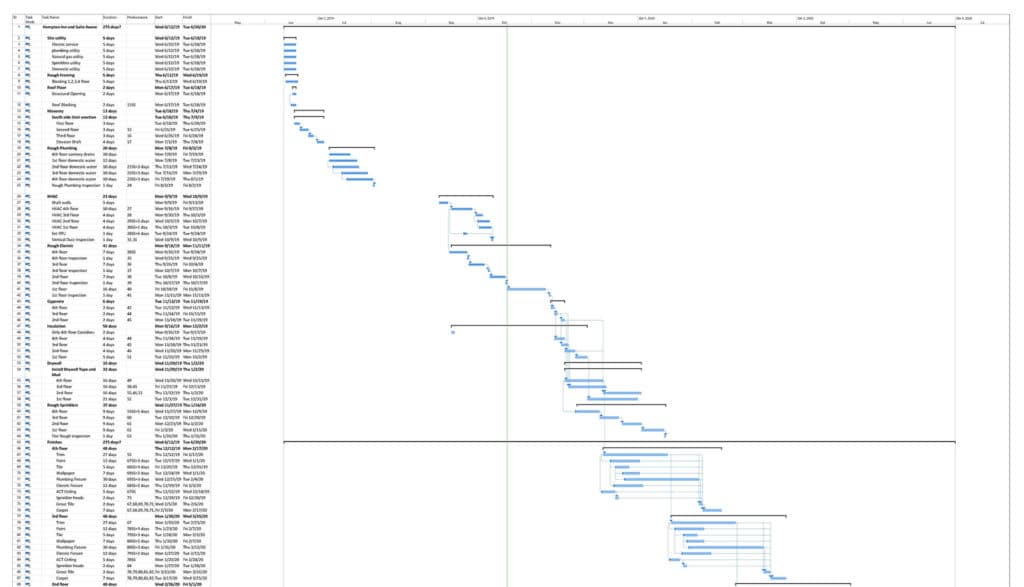
Related Article: “The 4D Way” – Collaboration of Schedule with 3D BIM Model
What is 5D BIM? Cost Estimation and Budget Management
5D BIM adds cost data to the 3D model by linking model elements to cost information. This enables real-time cost estimation, budget tracking, and the automatic generation of quantity takeoffs as the design evolves.
The connection between model geometry and cost works through quantity takeoffs. When model elements are properly specified and developed to LOD 300 or above, the model can generate accurate quantities automatically. Those quantities are then linked to cost rates to produce an estimated budget. As elements are revised, the quantities update, and so does the cost estimate.
This approach is useful not just for initial budget setting but throughout the entire project. 5D BIM allows project owners and their teams to analyse cost scenarios, understand the financial impact of scope changes, and track actual spending against the budget in real time. It removes much of the guesswork from cost forecasting and gives decision makers a reliable financial picture at every stage.
5D BIM Services can help in accurately predicting the budgetary requirements along with the changes in scope, material, manpower or equipment requirements. Get Cost-estimation for your project today.
Benefits of 5D BIM
- Real-time cost visibility, with immediate notification of cost changes when design decisions are made
- Automatic generation of component counts and material quantities directly from the model, reducing manual measurement errors
- Simplified scenario analysis, making it easy to compare the cost implications of different design options
- Reduced risk of budget overruns through continuous cost monitoring and reporting throughout the project
- Better cost certainty for owners and project sponsors, who can see the financial picture at every stage rather than only at key milestones
What is 6D BIM? Sustainability and Lifecycle Performance
6D BIM embeds sustainability intelligence directly into the model, enabling precise analysis of energy consumption, lifecycle costs, and environmental impact from the earliest design stages.
It shifts the focus from short-term construction outputs to long-term asset performance, allowing teams to make strategic decisions on materials, systems, and building orientation while changes are still efficient and cost-effective.
By enabling early-stage energy simulations and lifecycle evaluations, 6D BIM drives measurable improvements in operational efficiency, carbon reduction, and long-term cost optimization.
It also consolidates critical component data such as specifications, maintenance requirements, and performance metrics, creating a robust data foundation for both sustainability compliance and future facility operations.
Benefits of 6D BIM
- Early energy analysis during the design process, when changes are least expensive to implement
- Accurate prediction of a building's long-term energy consumption and operational costs
- Better decision making on component selection, based on the full lifecycle cost rather than just the upfront purchase price
- Improved sustainability compliance for projects targeting LEED, BREEAM, net-zero, or other environmental certifications
- Comprehensive facility data embedded in the model from construction, supporting efficient operations after handover
What is 7D BIM? - BIM 7th Dimension: Holistic Facility Management Information for Entire Lifecycle
7D BIM is all about adding facility management and asset data to the model. It captures information about each building component, including its status, maintenance requirements, warranty details, technical specifications, and operational history, so that building owners and facility managers have everything they need to operate and maintain the building effectively throughout its entire life.
The information captured in 7D BIM goes far beyond what is typically found in a traditional handover package. Rather than a collection of PDFs and paper manuals, 7D BIM provides a structured, searchable information model where every significant component is linked to its relevant operational data. A facility manager looking for the maintenance schedule for a specific air handling unit does not need to search through filing cabinets. The information is attached to that element in the model.
7D BIM is most effective when the groundwork is laid from the beginning of the project. Asset data standards should be defined at the BIM Execution Plan stage, and model element authors should be required to populate the relevant data fields as the design and construction progresses. When this is done well, the handover model is not just an as-built record but a fully operational facility management tool from day one.
Such a tactic helps in improving the quality of service delivery during the entire lifecycle of a project. Using BIM for facility management ensures that everything in a project stays in its best shape from day 1 to the day of demolition of a structure. At United-BIM Inc., we aim to deliver peace of mind and value BIM Modeling Services through quality, speed, and a consultative approach.
Related blog: How BIM is Facilitating Facility Management Process?
Benefits of 7D BIM
- Optimised asset and facility management from the day of handover through to the end of the building's operational life
- Faster, more accurate maintenance and repairs because all relevant component data is immediately accessible within the model
- Streamlined maintenance processes for contractors and specialist subcontractors, who can access the information they need directly
- Reduced operational costs over the building's life, because better information leads to more proactive and efficient maintenance
- A complete record of the building's components, specifications, and maintenance history, which is invaluable for future renovation or extension projects
From our experience working on handover projects, the most common failure in 7D BIM implementation is leaving data population too late. Teams that wait until construction is complete to populate asset data almost always end up with gaps and inconsistencies. The most successful projects define the required data fields in the BEP at the start and enforce them through the design and construction process.
What is 8D BIM? Safety Planning and Risk Management
8D BIM integrates safety intelligence into the 3D model by linking construction activities and model elements with risk data, safety protocols, and hazard identification. This enables proactive safety planning and real-time risk visualization before work begins on site.
The connection between the model and safety works through mapping high-risk zones, activities, and sequences directly within the BIM environment. When construction workflows are aligned with 4D scheduling and LOD-defined elements, teams can anticipate safety risks based on sequencing, site conditions, and trade interactions. As construction plans evolve, associated risks and safety measures update simultaneously.
This approach transforms safety from a reactive process into a predictive system. 8D BIM allows project teams to identify potential hazards early, simulate safe construction sequences, and ensure compliance with safety regulations. It significantly reduces on-site incidents by embedding safety considerations into planning and coordination workflows.
Benefits of 8D BIM
- Early identification of construction risks through model-based safety planning
- Improved site safety by linking hazards with construction sequences
- Better compliance with safety standards and regulations
- Reduced accidents and disruptions through proactive risk mitigation
- Enhanced communication of safety protocols across project teams
What is 9D BIM? Lean Construction and Performance Optimization
9D BIM introduces performance-driven intelligence into the model by integrating lean construction principles, resource planning, and workflow optimization. It enables teams to streamline operations, reduce inefficiencies, and improve overall project productivity.
The connection between the model and performance lies in mapping workflows, resource allocation, and execution strategies to BIM elements and construction sequences. By aligning 4D scheduling, 5D cost data, and real-time project inputs, 9D BIM provides a holistic view of how efficiently a project is progressing. As project conditions change, resource utilization and workflow performance can be continuously optimized.
This approach shifts BIM from a coordination tool to a performance engine. 9D BIM allows teams to identify bottlenecks, eliminate waste, and refine execution strategies across all project stages. It creates a data-driven environment where decisions are based on measurable efficiency rather than assumptions.
Benefits of 9D BIM
- Improved project efficiency through optimized workflows and resource planning
- Reduced material and time waste using lean construction strategies
- Enhanced productivity through data-driven performance tracking
- Better decision making with real-time project insights
- Increased project predictability and execution control
What is 10D BIM? Digital Twin and Lifecycle Intelligence
10D BIM extends the model into a fully integrated digital intelligence platform by combining all previous dimensions with advanced data systems such as digital twins, predictive analytics, and lifecycle optimization. It enables continuous monitoring and enhancement of asset performance beyond construction.
The connection between the model and lifecycle intelligence is established through real-time data integration. By linking BIM with sensors, IoT systems, and operational data, 10D BIM creates a dynamic representation of the built asset. As the building operates, performance data feeds back into the model, enabling predictive maintenance and long-term optimization.
This approach transforms BIM into a living system rather than a static model. 10D BIM allows stakeholders to anticipate failures, optimize asset performance, and make informed decisions throughout the building lifecycle. It bridges the gap between design, construction, and operations through continuous data flow.
Benefits of 10D BIM
- Real-time asset monitoring through digital twin integration
- Predictive maintenance using performance and operational data
- Improved lifecycle decision making based on continuous insights
- Enhanced operational efficiency and reduced downtime
- Long-term asset optimization through intelligent data integration
BIM dimensions transform a model from a design tool into a comprehensive decision-making system that spans the entire project lifecycle. From 3D visualization to 10D lifecycle intelligence, each dimension adds a critical layer of information that improves coordination, reduces risk, and enhances long-term asset performance.
While not every project requires all dimensions, understanding how and when to apply them gives project teams a clear strategic advantage. The real value of BIM lies not just in creating models, but in leveraging the right level of information at the right stage to drive better outcomes.
BIM dimensions refer to the different types of information added to a BIM model beyond 3D geometry. These include time, cost, sustainability, facility management, and advanced lifecycle data.
3D BIM focuses on geometry and design. 4D BIM adds time and scheduling. 5D BIM integrates cost data, enabling real-time budgeting and quantity takeoffs.
6D BIM is used for sustainability and energy analysis. It helps evaluate lifecycle costs, energy performance, and environmental impact from early design stages.
7D BIM focuses on facility management. It includes asset data, maintenance schedules, and operational information used after construction is complete.
8D BIM integrates safety planning into the model. It helps identify risks, visualize hazards, and improve construction site safety through proactive planning
9D BIM focuses on lean construction and performance optimization. It improves efficiency by reducing waste, optimizing workflows, and enhancing productivity.
10D BIM represents lifecycle intelligence through digital twins and predictive analytics. It enables real-time monitoring and long-term asset optimization.
BIM dimensions from 3D to 7D are widely accepted, but 8D, 9D, and 10D are not fully standardized and may vary depending on project or organization.
3D BIM is fundamental for all projects, while higher dimensions like 4D, 5D, and 6D become important depending on project complexity and requirements.
LOD defines how detailed and reliable a model element is, while BIM dimensions define the type of information in the model. Both work together in BIM workflows.
5D BIM is used for cost estimation. It links model elements with cost data to provide real-time budget tracking and quantity takeoffs.
4D BIM is used for scheduling. It connects time data with the model to visualize construction sequences and project timelines.
Not necessarily. Smaller projects may only use 3D or 4D, while large or complex projects benefit from higher dimensions like 6D, 7D, or beyond.
Infrastructure, healthcare, commercial buildings, and industrial projects benefit the most due to their complexity and long lifecycle requirements
BIM dimensions improve decision making, enhance coordination, reduce risks, and enable better lifecycle management of assets, making projects more efficient and predictable.
About the Author

Coordination Manager / VDC Manager at United BIM
With over 10 years of experience in the AEC industry, Akash Patel is a seasoned Coordination Manager and VDC Manager at United BIM. His expertise lies in managing complex MEP-FP coordination projects and leveraging cutting-edge BIM technology to ensure seamless collaboration and precision. Akash is dedicated to delivering high-quality, detailed models that meet the demands of modern construction. He is passionate about optimizing workflows and driving innovation within the BIM field.