Last updated on: November 27, 2025
Table of Contents
Outsourcing has become an essential strategic approach for architectural and engineering firms that want to scale production, maintain quality, and manage complex project timelines efficiently. As client expectations rise across the AEC industry, firms must deliver consistent output without compromising creativity or delivery speed. Architectural outsourcing helps firms achieve this by providing access to skilled production teams without expanding internal staff.
Before exploring how outsourcing strengthens workflows today, it is useful to understand how it evolved into a core operating model.
How Outsourcing Became Integral to AEC Production Workflows
Architectural outsourcing began in the late 1970s when firms delegated repetitive drafting tasks to external teams so internal designers could focus on planning and client coordination. By the 1990s, outsourcing matured into a strategic function helping firms reduce costs, increase flexibility, and deliver more projects without staff expansion.
Today, architectural outsourcing covers a wide variety of production tasks including CAD drafting, Revit modeling, BIM documentation, mark-up corrections, and construction documents. It is widely used by firms aiming to meet evolving project demands efficiently and cost-effectively.
Scope of Architectural Outsourcing
Architectural outsourcing supports several stages of design and documentation. This section helps A/E firms understand the breadth of tasks that can be delegated to a specialized partner.
Key inclusions in the scope are:
- Architectural CAD drafting
- Revit modeling for all LOD levels
- Construction documentation
- Redline and markup updates
- CAD to BIM conversions
- As-built and record documentation
- 3D architectural modeling
- Sheet creation and annotations
- Revit family creation
- Permit and planning drawing support
- Template and project setup
- Architectural visualization (where relevant)
- Production assistance across SD, DD, and CD phases
This range makes outsourcing a powerful tool for managing both routine production and complex modeling tasks.
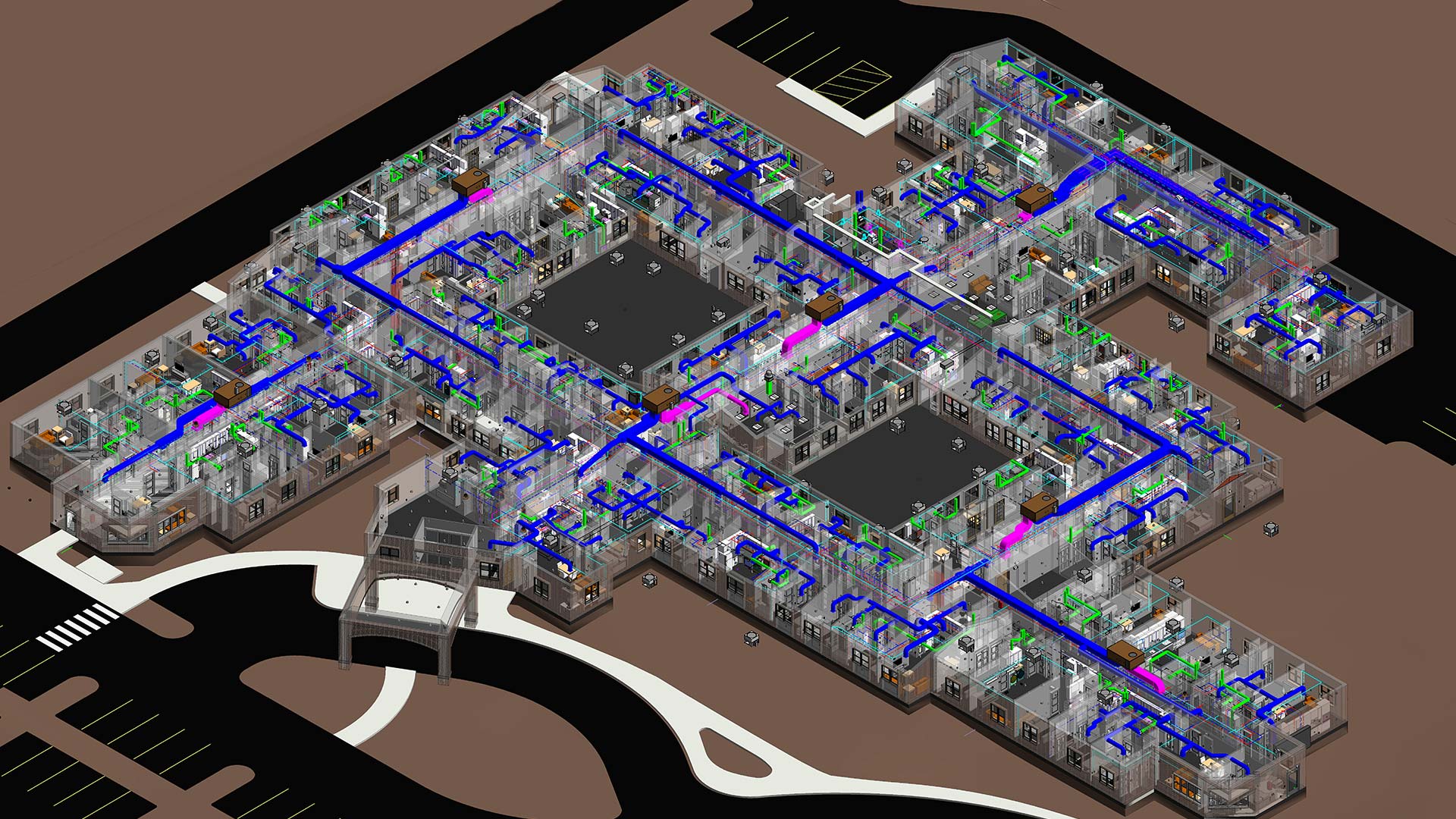
See how a Hartford, CT apartment project used outsourced BIM and architectural production to meet tight deadlines with complete accuracy.
Why Architectural Outsourcing Should Be Part of Your Operational Strategy
Architectural outsourcing provides A/E firms with tangible, measurable benefits across cost, efficiency, and scalability. These advantages apply to both project delivery and long-term business growth.

Reduced Cost of Operations
Outsourcing allows firms to access trained drafting and BIM professionals without incurring full-time hiring, software licensing, training, or infrastructure costs. This results in predictable production budgets and improved resource allocation for design development, client presentations, and technology investment.
Enhanced Focus on Core Activities
Architects and engineers create greater value when focused on conceptual design, iterations, client communication, and construction coordination. Outsourcing drafting, modeling, and documentation ensures that internal teams stay focused on strategic responsibilities rather than production-heavy tasks.
Improved Turnaround Time and Deadline Compliance
Outsourcing partners add flexible capacity that helps firms meet tight project deadlines. Offshore teams can operate in overlapping or extended hours, reducing the overall cycle time for reviews and deliverables. Faster turnaround enhances client satisfaction and strengthens the firm’s reputation.
When Should A/E Firms Consider Outsourcing
A/E firms typically consider outsourcing when:
- Project workload exceeds in-house capacity
- Multiple deadlines overlap
- Specialized Revit or BIM expertise is required
- Staff availability fluctuates due to seasonality
- CAD or BIM production slows down higher-value work
- A new project requires rapid scaling
- Cost efficiency becomes a priority
- Internal teams need relief from repetitive tasks
These triggers help firms maintain delivery quality without compromising operational efficiency. And outsourcing helps firms increase their overall project capacity, strengthen delivery reliability, and open avenues for new business. As clients receive consistently high-quality deliverables, referral opportunities and repeat business grow.
More output capacity means firms can pursue additional projects and maintain better client relationships, driving long-term expansion.
How to Choose the Right Architectural Outsourcing Partner
Selecting the right partner ensures seamless workflow integration, quality, and long-term reliability. Below is a practical checklist for A/E firms evaluating outsourcing providers.
Look for strong capability in:
- Architectural drafting
- Revit modeling
- BIM documentation
- CAD to BIM
- Architectural CAD outsourcing
- US construction standards and AIA conventions
A good outsourcing partner uses:
- BIM 360 or Autodesk Construction Cloud
- Bluebeam for markups
- Shared drives or CDEs
- Scheduled progress reporting
Quality should be backed by:
- Multi-level QC
- Standardized workflows
- Strong review processes
- Clean and reusable templates
- Consistent documentation practices
Choose partners that can quickly increase or decrease team size based on project workload or sudden requirements.
Important factors include:
- NDA compliance
- Secure file sharing
- Controlled project access
- Confidentiality standards
Ensure clarity around:
- Billing model
- Revision cycles
- Scope boundaries
- Delivery schedule expectations
Transparency supports long-term collaboration.
Benefits Specific to Different Firm Types
Architectural outsourcing benefits all firm sizes, but the value varies based on structure and workload.
Architectural outsourcing benefits all firm sizes, but the value varies based on structure and workload.
Small Architectural Firms
- Access to skilled drafting and modeling support
- Ability to take on larger projects
- Lower overhead costs
Mid-size Firms
- Flexible workload management
- Parallel production support
- Improved project turnaround
Large Firms
- High-volume documentation support
- Multi-project capacity scaling
- Strong global delivery models
Design-build Firms
- Faster delivery cycles
- Support for construction-driven documentation
- Reliable modeling output for coordination
These benefits extend across design studios, engineering consultants, general contractors, and developers.
Conclusion
Architectural outsourcing gives A/E firms the flexibility, capacity, and efficiency required to deliver high-quality projects consistently. By partnering with a reliable outsourcing provider, firms can reduce operational costs, improve production speed, and strengthen their competitive advantage.
If you want to outsource architectural drafting, BIM modeling, or documentation tasks, United BIM can support your workflow with accuracy and speed.
Contact us at +1 (860) 317-7105 or email us at info@united-bim.com
Drafting, CAD documentation, BIM modeling, mark-ups, construction documents, Revit family creation, and architectural production tasks can be outsourced.
Yes. Many firms rely on architectural outsourcing companies for large CD packages and multi-discipline modeling support.
It eliminates hiring, training, software, and overhead expenses while providing skilled production resources.
Yes. Outsourcing partners offer scalable teams that support tight schedules and overlapping production cycles.
Select a partner with structured QC practices, experience with AIA standards, and clear communication workflows.
About the Author

Coordination Manager / VDC Manager at United BIM
With over 10 years of experience in the AEC industry, Akash Patel is a seasoned Coordination Manager and VDC Manager at United BIM. His expertise lies in managing complex MEP-FP coordination projects and leveraging cutting-edge BIM technology to ensure seamless collaboration and precision. Akash is dedicated to delivering high-quality, detailed models that meet the demands of modern construction. He is passionate about optimizing workflows and driving innovation within the BIM field.