Last updated on: April 16, 2026
Table of Contents
In construction projects, planning does not start on site. It starts with understanding what needs to be built, how much material is required, and how costs will be managed. Two documents that play a critical role at this stage are the BOQ (Bill of Quantities) and BOM (Bill of Materials).
Although these terms are often used together, they serve different purposes and are prepared for different reasons. This blog explains what BOQ and BOM mean, what they include, who prepares them, how they differ, and why both are important in construction project planning.
What is BOQ (Bill of Quantities) in Construction?
A Bill of Quantities (BOQ) is a structured document used in construction projects to list the quantities of work items required to complete a project. It acts as a common reference point for owners, consultants, and contractors during tendering and execution.
Instead of leaving scope interpretation open to individuals, a BOQ clearly defines what work is included and in what quantity, helping reduce ambiguity during bidding and construction.
BOQ Full Form and Meaning
The full form of BOQ is Bill of Quantities.
In construction, BOQ refers to a detailed statement of work items, materials, and quantities prepared based on drawings and technical specifications.
What Does a BOQ Include?
A BOQ typically includes a clear breakdown of construction work. While formats may vary, most BOQs contain:
- Description of each work item
- Unit of measurement such as square meters, cubic meters, or numbers
- Quantities required for each item
- References to drawings or specifications where applicable
These details allow contractors to price work consistently and help project teams track quantities throughout the project lifecycle
Purpose of BOQ in Construction Projects
The primary purpose of a BOQ is to bring structure and transparency to the tendering and cost estimation process. It helps ensure that all bidders are pricing the same scope of work, making comparisons fair and meaningful.
- Beyond tendering, BOQs also support:
- Cost planning and budget control
- Measurement of completed work
- Valuation of variations and changes
- Progress tracking during construction
Who Makes a BOQ?
BOQs are usually prepared by quantity surveyors or cost consultants. In some projects, estimation teams or design consultants may also be involved. The BOQ is developed using construction drawings, specifications, and project scope documents, and its accuracy depends heavily on the quality of input information.
What is BOM (Bill of Materials)?
A Bill of Materials (BOM) focuses on materials rather than work items. It is a detailed list of materials, components, or parts required to build a specific system or product.
In construction projects, BOMs are commonly used to support material planning, procurement, and inventory control, especially for services, prefabricated elements, or manufactured components.
BOM Full Form and Meaning
The full form of BOM is Bill of Materials.
It represents a structured list of materials needed to execute a particular scope of work or assembly.
What Does a BOM Include?
A BOM generally provides material-level information, such as:
- Material or component names
- Quantities required
- Specifications or grades
- Part numbers or identifiers
- Supplier or manufacturer references, where applicable
Unlike a BOQ, a BOM usually does not focus on labor or cost breakdowns.
Purpose of BOM in Projects
The purpose of a BOM is to ensure that the right materials are available at the right time. It supports:
- Procurement planning
- Inventory management
- Coordination between design and construction teams
- Reduction of material shortages or excess ordering
By providing clarity on material requirements, BOMs help improve efficiency and reduce delays caused by missing components.
Who Makes a BOM?
BOMs are typically prepared by engineers, design teams, or procurement teams. In construction, they may be derived from design drawings, specifications, or digital models, depending on the project workflow.
Key Differences Between BOQ and BOM
Although BOQ and BOM are closely related, they are not the same. Understanding the difference helps teams use each document correctly.
| Aspect | BOQ (Bill of Quantities) | BOM (Bill of Materials) |
|---|---|---|
| Main focus | Quantities of work items | Materials and components |
| Used for | Tendering and cost estimation | Procurement and inventory |
| Industry usage | Construction projects | Construction and manufacturing |
| Prepared by | Quantity surveyors, estimators | Engineers, design teams |
| Cost information | Often included | Usually quantity-focused |
In simple terms, a BOQ looks at what work needs to be done, while a BOM focuses on what materials are needed.
Why BOQ and BOM Are Important in Project Planning
BOQ and BOM together provide a clear picture of a project’s material and quantity requirements. This clarity helps project teams:
- Plan budgets more accurately
- Improve coordination between stakeholders
- Reduce uncertainty during procurement
- Avoid delays caused by missing or incorrect materials
When these documents are prepared accurately, they support better decision-making and contribute to smoother project execution.
How BIM Improves the Development Process of BOQ and BOM
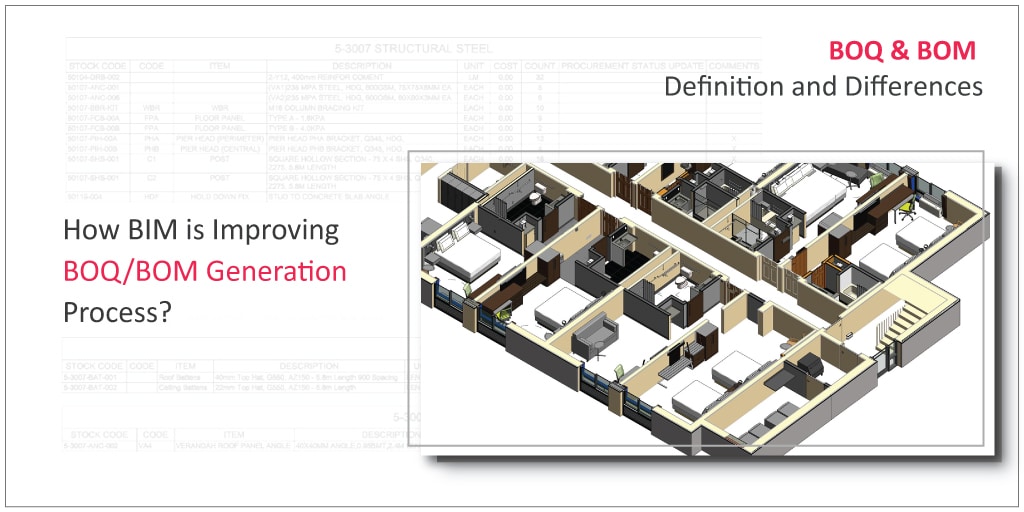
Traditionally, BOQ and BOM were prepared using 2D drawings and spreadsheets. Quantities were measured manually, and any design change required the documents to be reviewed and updated again. This made the process time-consuming and increased the chances of errors, especially on complex projects.
Building Information Modeling (BIM) changes this process by linking quantities and materials directly to a digital 3D model. Instead of relying only on drawings, project teams can extract information from model elements that already contain data about size, type, and material.
Improved Accuracy in Quantity Takeoff
One of the biggest advantages of BIM is improved accuracy. Since quantities are derived directly from modeled elements, the risk of missing or double-counting items is reduced. This helps in creating more reliable BOQs and BOMs, especially for projects with repetitive or complex components.
Faster Updates When Design Changes Occur
Design changes are common in construction projects. In a traditional workflow, even small changes could require reworking multiple spreadsheets. With BIM, updates to the model automatically reflect in quantity schedules, helping teams keep BOQ and BOM information aligned with the latest design.
Better Coordination Between Disciplines
BIM models combine architectural, structural, and MEP information in a single environment. This coordination improves the quality of BOQs and BOMs by reducing inconsistencies between different disciplines and minimizing gaps in quantity or material information.
Support for Planning and Cost Control
BIM-based quantities can be linked with project schedules and cost data, supporting better planning and cost control. While advanced applications such as 4D and 5D BIM go deeper into scheduling and cost management, even basic BIM workflows provide a clearer and more structured approach to developing BOQs and BOMs.
Clearer Information for Project Teams
By using BIM, BOQ and BOM data becomes easier to review and understand. Visual models help project teams verify quantities and material requirements, reducing misunderstandings and improving confidence in the information used for procurement and planning.
Conclusion
BOQ and BOM are essential documents in construction and project planning, each serving a specific purpose. A BOQ supports cost estimation and tendering by clearly defining work quantities, while a BOM helps manage material requirements and procurement.
Understanding the role and difference between BOQ and BOM allows project teams to plan more effectively, reduce risks, and maintain better control over costs and materials throughout the project lifecycle.
The main difference between a Bill of Materials (BOM) and a Bill of Quantities (BOQ) lies in their purpose and focus. A BOM lists the materials and components required to build a system or product and is mainly used for procurement and inventory planning. A BOQ, on the other hand, quantifies construction work items and is used for cost estimation, tendering, and contract management in construction projects.
The full form of BOQ in construction is Bill of Quantities. It is a detailed document that lists construction work items, their quantities, and descriptions based on project drawings and specifications.
Using a BOQ helps improve cost transparency and consistency during tendering. It allows contractors to price the same scope of work, supports accurate cost estimation, and serves as a reference for progress tracking, valuation of variations, and overall cost control throughout the project.
BOQs are commonly used by quantity surveyors, contractors, project managers, consultants, and clients. They help all stakeholders understand the project scope, quantities, and costs, making them an essential document throughout the construction lifecycle.
BOQ stands for Bill of Quantities, a document that lists materials, quantities, and scope of work for a construction project
BOQ is used in construction and includes quantities of work items (often with labor and costs), while BOM is used in manufacturing and lists only materials/components.
Example:
• BOQ: Concrete – 50 m³, Steel – 5 tons (may include labor & cost)
• BOM: Bolts – 100 pcs, Steel plates – 20 units (materials only)
No. Quantity Takeoff is the process of measuring quantities from drawings, while a Bill of Quantities is a formal document listing those quantities for pricing and tendering.
About the Author

Coordination Manager / VDC Manager at United BIM
With over 10 years of experience in the AEC industry, Akash Patel is a seasoned Coordination Manager and VDC Manager at United BIM. His expertise lies in managing complex MEP-FP coordination projects and leveraging cutting-edge BIM technology to ensure seamless collaboration and precision. Akash is dedicated to delivering high-quality, detailed models that meet the demands of modern construction. He is passionate about optimizing workflows and driving innovation within the BIM field.