Design to Fabrication Infographic
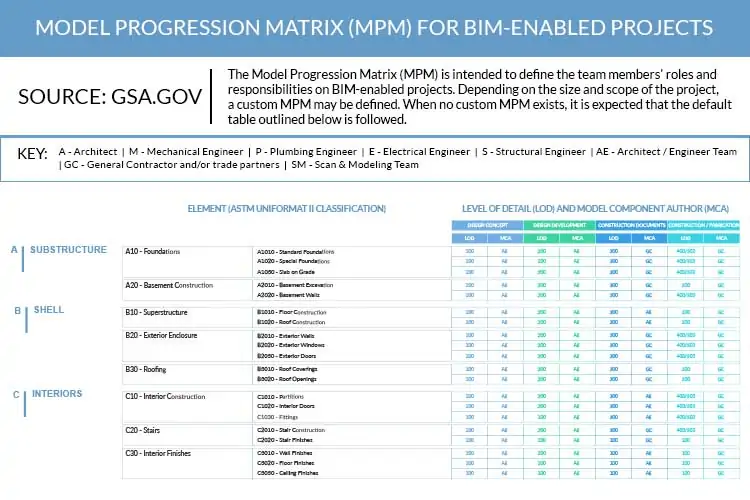
Model Progression Matrix (MPM) – Building Design Phases, LOD, and Model Ownership
The Model Progression Matrix (MPM) is a structured framework that defines how BIM elements evolve across different building design phases in terms of Level of Development (LOD) and model ownership.
It helps project teams clearly understand which elements are developed at each stage, the expected level of detail, and the responsibility of each stakeholder.
This checklist is designed to simplify the interpretation of MPM and support better coordination, planning, and execution across BIM-enabled projects.
You can contact Richard Gee from GSA (richard.gee@gsa.gov) to know more in details.
This checklist is particularly useful for:
- BIM Managers and VDC professionals defining model progression and ownership
- Architects and engineers working across multiple design stages
- Contractors involved in coordination and model-based planning
- Project teams preparing BIM Execution Plans (BEP/BXP)
- Stakeholders managing BIM deliverables and responsibilities
This is useful for:
- Relationship between ASTM Uniformat II elements and LOD levels
- Model ownership across different building design phases
- How BIM elements progress from concept to as-built stage
- Alignment of MPM with BIM Execution Plan (BEP/BXP)
- Roles and responsibilities of project team members
Insight Section
If model progression and ownership are not clearly defined, teams may face confusion in responsibilities, coordination issues, and gaps in deliverables.
This checklist helps bring clarity to model development, improves coordination, and supports structured BIM workflows across the project lifecycle.
Explore More BIM Resources
Frequently Asked Questions
MPM is a framework that defines how BIM elements progress across design phases along with assigned responsibilities.
It includes relationships between building elements, LOD levels, and model ownership.
It is a standardized system used to classify building elements in construction projects.
MPM is used to define model development stages and assign responsibilities to different stakeholders.
It helps improve coordination, clarity, and accountability in BIM workflows.
LOD defines the level of detail and information expected for each element at each stage.
It is typically prepared as part of the BIM Execution Plan by BIM managers or project teams.
It ensures each team knows their scope and responsibilities at every phase.
Yes, it applies to new construction, renovation, and retrofit projects.
It defines which team or discipline is responsible for creating and updating model elements.
MPM is often included in the BIM Execution Plan to define workflows and responsibilities.
It can lead to confusion, delays, and coordination issues.
It is based on standards like GSA guidelines but can be adapted for project needs.
By aligning it with project phases, defining clear roles, and updating it as needed.
A printed version helps teams quickly reference roles, responsibilities, and LOD requirements during coordination.